

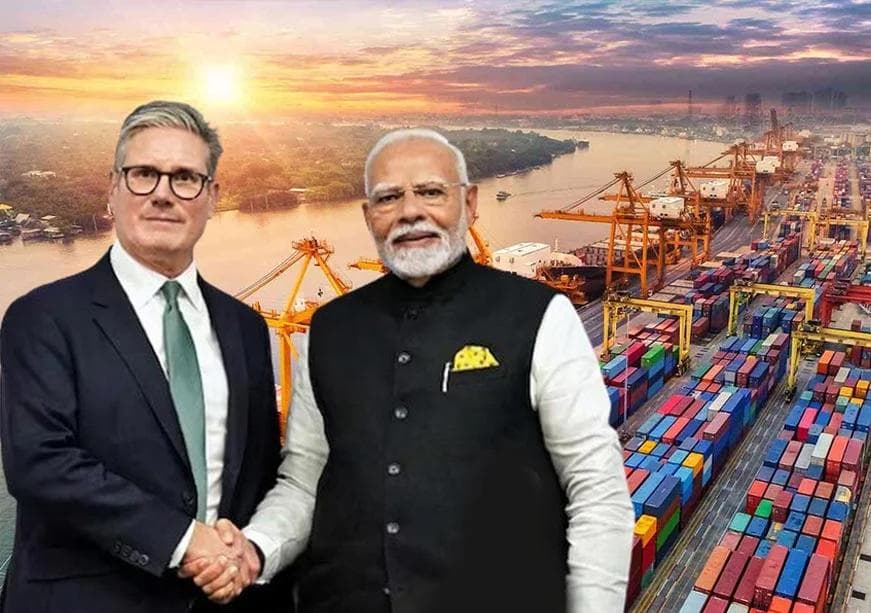

For decades, Indian jewellery manufacturers exporting to the United Kingdom absorbed import duties of up to 4% just to compete in one of Europe's most valuable jewellery markets. That changed on 15 July 2026, when the India-UK Comprehensive Economic and Trade Agreement (CETA) came into force, eliminating those tariffs entirely. For B2B manufacturers, exporters, and MSMEs in the gems and jewellery sector, this is not a symbolic milestone; it's a direct shift in cost structure and competitiveness.
What Changed, Exactly
Under the earlier trade regime, Indian gems and jewellery exports faced UK import duties ranging from 2.5 per cent to 4 per cent, according to Santosh Mishra, Customs Commissioner, speaking at an industry event. Under CETA, those duties are being brought down to zero, giving Indian exporters more competitive footing in the wider European market.
The scale of the opportunity is significant. GJEPC Chairman Kirit Bhansali noted that with tariffs of up to 4% eliminated, Indian exporters gain a meaningful edge in the UK's roughly $4 billion jewellery import market. Industry estimates suggest India's gem and jewellery exports to the UK could climb from around $754 million to nearly $2.5 billion over the coming years.
GJEPC Vice Chairman Shaunak Parekh went further, projecting that the industry could nearly triple its exports within three years, with the biggest gains flowing to exporters, MSMEs, and jewellery manufacturers specifically.
The First Shipments Are Already Moving
This isn't a projection sitting in a policy document — it's already operational. On the very first day CETA took effect, more than 30 exporters shipped roughly $10 million worth of gold, diamond, silver, and platinum jewellery from Mumbai, Delhi, Surat, Jaipur, Chennai, and Kolkata in coordinated flag-off events. In Mumbai specifically, ceremonies were held at both Bharat Diamond Bourse and SEEPZ-SEZ, the city's two dominant jewellery export clusters, with Customs and DGFT officials in attendance to mark the occasion.
On the retail-import side, Malabar Gold & Diamonds became one of the first companies to import jewellery into the UK under the new agreement, with its chairman M.P. Ahammad framing it as reinforcement of a "Make in India; Market to the World" strategy. The company is using the momentum to expand its UK footprint with new showrooms in Manchester and London, while also eyeing France and Ireland as adjacent European markets.
At the ground level, Dnyaneshwar Patil, Development Commissioner at SEEPZ, put numbers to the shift: exports from the zone currently running at around Rs 3,000 crore are expected to nearly double to Rs 6,000 crore as the duty advantage takes hold.
Why This Matters for Manufacturers
For jewellery manufacturing businesses that supply exporters or run their own export operations, three practical implications stand out:
- Lower landed cost, better pricing power. Removing a 2.5–4% duty directly widens margins or allows for more competitive UK pricing, a real advantage against European and other Asian manufacturing hubs.
- MSMEs get a proportionally bigger lift. Officials have specifically flagged small and mid-sized manufacturers as prime beneficiaries, since duty savings matter more on thinner margins.
- Faster customs facilitation is part of the deal. Officials in Mumbai committed to faster clearances and reduced dwell times to help exporters actually capture these benefits operationally, not just on paper.
The Takeaway
The India-UK FTA isn't a future promise, it's an active trade corridor with shipments, showroom expansions, and revenue targets already in motion. For manufacturers weighing whether to build or scale UK-facing export capacity, the duty elimination, combined with GJEPC's active coordination with Customs and DGFT, makes this one of the more concrete tailwinds the industry has seen in years. The window to build supply relationships and certifications for this corridor is open now, while first-mover advantage is still available.
Surat's manufacturing base is central to this shift: the city was one of the locations where India's first CETA jewellery shipments went out on day one, alongside Mumbai, Delhi, Jaipur, Chennai, and Kolkata. At Kays Diamonds, we've been manufacturing and exporting to the UK from our Surat facility for years, working with international jewelry brands and retailers on custom diamond collections. As zero-duty access reshapes the cost equation for UK-bound orders, we're well placed to help partners and buyers capitalize on this window, from product development through to export-ready delivery. If you're evaluating manufacturing partners for the UK market, we'd be glad to talk through your requirements.